On Saturday, Hong Kong's professional institutes of architecture, landscape, planning, urban design, surveying, and architectural conservation co-organized their third forum on Hong Kong's Northern Metropolis. Design and planning programmes from four universities in Hong Kong presented studios, student theses, and research in and around the site of the future Northern Metropolis.

HKU's Division of Landscape Architecture presented two Master of Landscape Architecture theses by HUI Chun-sing and Ceas CHONG Yan Suen, both advised by professor Ashley Scott Kelly:
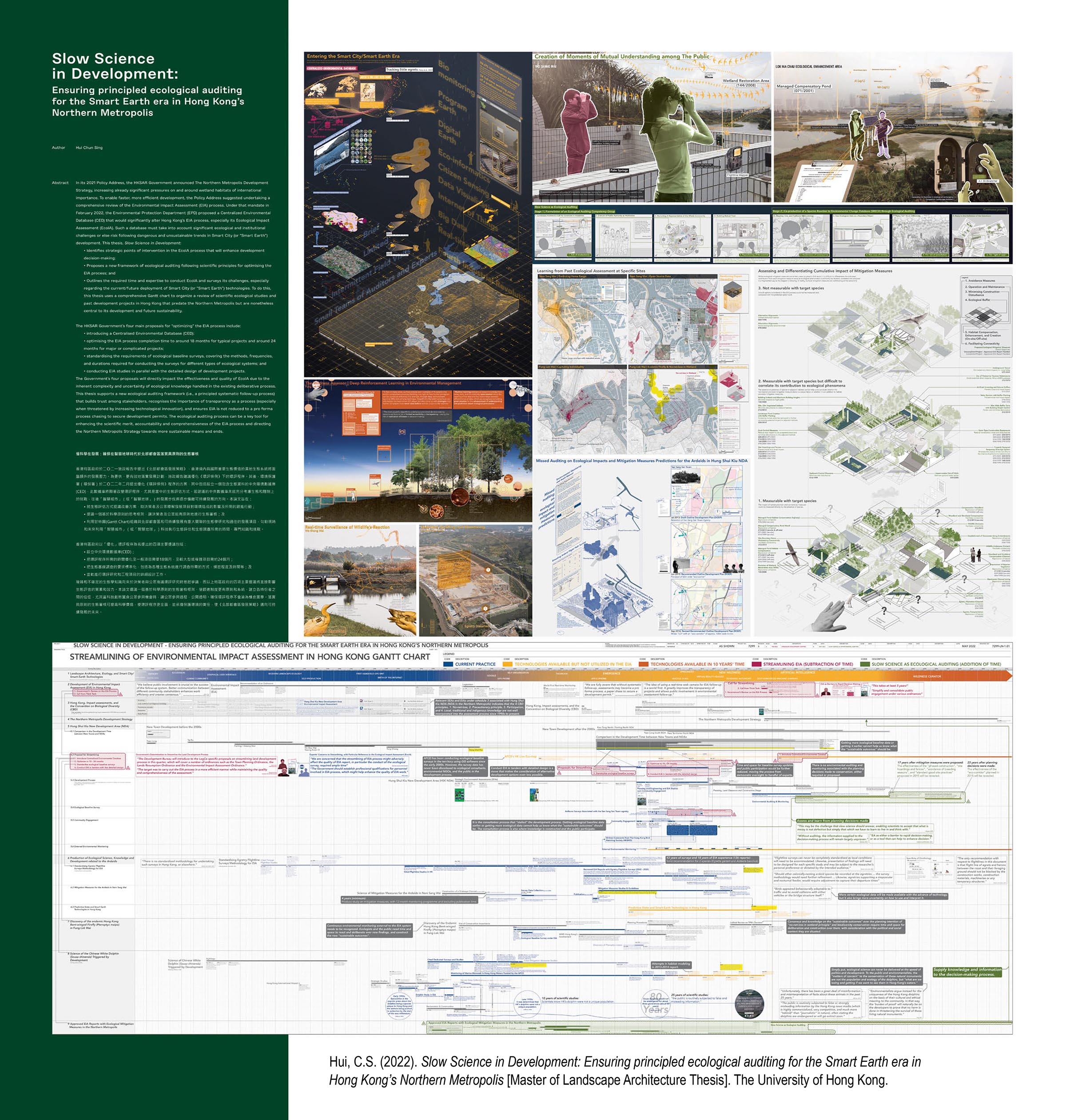
Slow Science in Development: Ensuring principled ecological auditing for the Smart City era in Hong Kong's Northern Metropolis
Thesis by: HUI Chun-sing
Advised by: Ashley Scott Kelly
Abstract: The Northern Metropolis increases already significant pressures on and around wetland habitats of international importance. To enable faster, more efficient development, the 2021 Policy Address suggested undertaking a comprehensive review of the Environmental Impact Assessment (EIA) process. Under that mandate in February 2022, the Environmental Protection Department (EPD) proposed a Centralized Environmental Database (CED) that would significantly alter Hong Kong's EIA process, especially its Ecological Impact Assessment (EcoIA). Such a database must take into account significant ecological and institutional challenges or else risk following dangerous and unsustainable trends in Smart City (or "Smart Earth") development. This design project: identifies strategic points of intervention in the EcoIA process that will enhance development decision-making; proposes a new framework of ecological auditing following scientific principles for optimising the EIA process; and outlines the required time and expertise to conduct EcoIA and surveys its challenges, especially regarding the current/future deployment of Smart City (or "Smart Earth") technologies. To do this, this design project uses a comprehensive Gantt chart to organize a review of scientific ecological studies and past development projects in Hong Kong that predate the Northern Metropolis but are nonetheless central to its development and future sustainability. The Government's four main proposals for "optimizing" the EIA process include: introducing a Centralised Environmental Database (CED); optimising the EIA process completion time to around 18 months for typical projects and around 24 months for major or complicated projects; standardising the requirements of ecological baseline surveys, covering the methods, frequencies, and durations required for conducting the surveys for different types of ecological systems; and conducting EIA studies in parallel with the detailed design of development projects. The Government's four proposals will directly impact the effectiveness and quality of EcoIA due to the inherent complexity and uncertainty of ecological knowledge handled in the existing deliberative process. This design project supports a new ecological auditing framework (i.e., a principled systematic follow-up process) that builds trust among stakeholders, recognises the importance of transparency as a process (especially when threatened by increasing technological innovation), and ensures EIA is not reduced to a pro forma process chasing to secure development permits. The ecological auditing process can be a key tool for enhancing the scientific merit, accountability and comprehensiveness of the EIA process and directing the Northern Metropolis Strategy towards more sustainable means and ends.

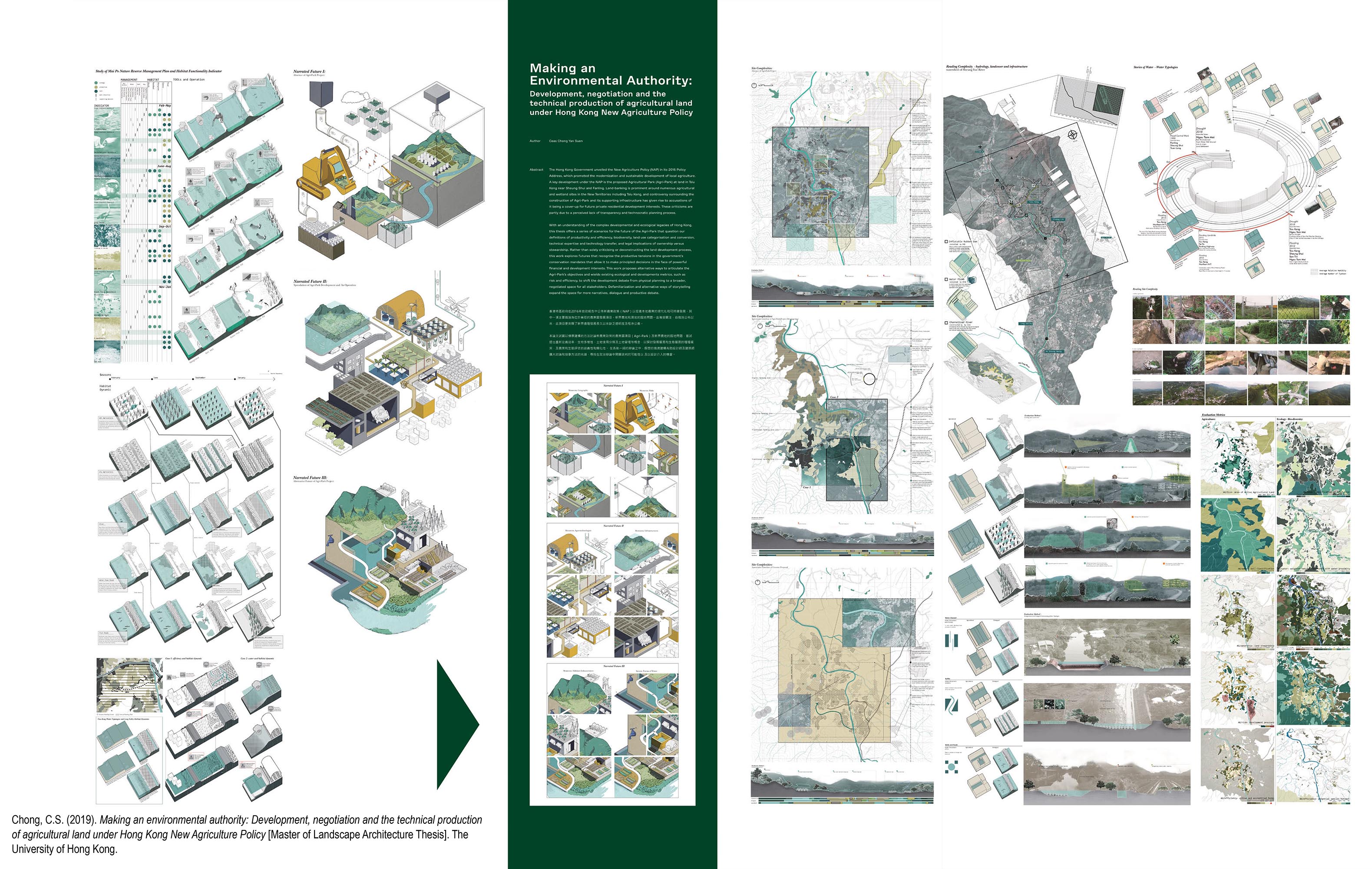
Making an environmental authority: Development, negotiation and the technical production of agricultural land under Hong Kong New Agriculture Policy
Thesis by: Ceas CHONG Yan Suen
Advised by: Ashley Scott Kelly
Abstract: The Northern Metropolis will integrate agricultural programmes with urban planning, including multistorey farming, urban agriculture, and continued development of the Agricultural Park (Agri-Park)—a hub for agro-technology, knowledge transfer, and modern farm management established by the 2016 New Agriculture Policy. However, the drive towards modernisation raises critical questions about how productivity, sustainability, and conservation are defined and measured, especially as urbanisation accelerates in the New Territories. Additionally, the legacy of land-banking, land conversion disputes, development delays and cost overruns, benefits of supporting infrastructures, and farm leasing and production issues has heightened concerns about transparency and the potential prioritisation of private development interests. Drawing on the complex developmental and ecological legacies of Hong Kong, including numerous wetland and agricultural sites in the New Territories, this thesis offers a series of scenarios for the future of the Agri-Park that question our definitions of productivity and efficiency, biodiversity, land use categorisation and conversion, technical expertise and technology transfer, and implications of ownership versus stewardship. Rather than solely critiquing or deconstructing the land development process, this work explores futures that recognise the productive tensions in the government's conservation mandates that allow it to make principled decisions amidst powerful financial and development interests. This work proposes alternative ways to articulate the Agri-Park's objectives and wields existing ecological and development metrics, such as risk and efficiency, to shift the development debate from physical planning to a more inclusive, negotiated space for all stakeholders.
Posted by: Ashley Scott Kelly (ashleyscottkelly.com)